
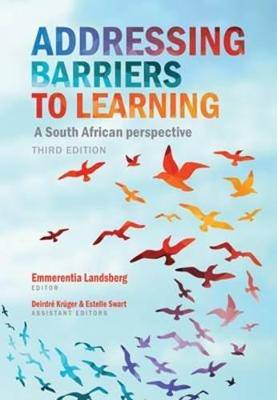
Description
Everyone has the right to education. The main objective of any education system in a democratic society is to provide quality education for all learners so that they will be able to reach their full potential and contribute meaningfully to and participate in that society throughout their lives. With the publication of the Education White Paper 6 in 2001, South Africa proclaimed its policy of inclusive education; however, this policy is not always clearly understood by educators. Addressing barriers to learning provides relevant and in-depth knowledge to prepare educators better to teach all the learners in their class groups.
Addressing barriers to learning covers the complete continuum of barriers to learning as reflected in the Education White Paper 6, including the most vulnerable of them: those who are economically and educationally disadvantaged; those with physical, sensory, intellectual, and/or learning impairment; and those displaying challenging behaviour who are at risk of exclusion. Case studies offer practical examples and activities provide opportunities for hands-on experience with classroom practice and management, collaboration with all role players and mobilisation of community involvement, which is at the heart of true inclusion.
Addressing barriers to learning is aimed at both prospective and current educators and other support professionals, including psychologists and therapists.
The three editors, Emmerentia Landsberg, Deirdre Kruger and Estelle Swart, are acknowledged and experienced academics and practitioners in the field of inclusive education and accommodating diversity in inclusive classrooms.







Reviews
There are no reviews yet.